
Time Tracking with Jobilino vs. Paperwork
Why digital time tracking replaces paper, timesheets and Excel.
- No more carrying sheets between the site and the office
- Legible figures instead of deciphered handwriting
- Retention without folders and without searching
Many companies still record working hours using paper, timesheets or Excel. The comparison of digital vs. paper time tracking quickly shows how much time, money and effort can be saved with digital time tracking.
The major disadvantage of time tracking with paper
Paper timesheets seem simple, but in practice they cause a great deal of effort, errors and a lack of transparency.
- The sheet is in the van, the locker or a jacket – and reaches the office days later, if at all
- Handwriting gets misread: a 1 becomes a 7, and 7:30 becomes 7:80
- A lost sheet is gone for good – the hours are estimated or written off
- While the sheets are in transit, nobody in the office knows who is working where today
- Records have to be kept for years – on paper that means folders, space and searching when it matters
The solution: Digital time tracking with Jobilino
Digital time tracking replaces paperwork and creates clear, traceable working hours.
Paper and digital side by side
The journey disappears, not just the paper
The real gain is not the sheet you save but the transport: sheets have to be collected, sorted and brought to the office. A clock-in is there the moment it happens.
Legible instead of deciphered
Digital figures need no interpretation. That ends the round of follow-up questions which costs many businesses the start of every month – and which nobody books as working time.
Nothing gets lost any more
A sheet can get wet, disappear or end up in the wrong pile. An entry in the system is still there even if the phone breaks – backed up and with a timestamp.
An overview on the same day
Who is at which site today, and whether anyone clocked in at all, is available immediately – not only once the sheets arrive.
How time tracking with Jobilino works
-
Retire the timesheets – on a fixed date
Do not let them run on in parallel. Two systems side by side mean double the work and, at month end, two sets of figures nobody reconciles.
-
Roll out the app, sign in once
Employees install the app and sign in once. Anyone without their own device clocks in at a terminal or with an NFC chip.
-
Stay close during the first week
Experience shows the first five days decide whether people clock in at all. Answer questions that week and there are hardly any afterwards.
-
Report instead of re-typing
From the first month end there is nothing left to transcribe. The hours are already in the system – filtered by employee, project or period.
What paper cannot do at all
Proof that somebody was on site
An NFC tag documents the moment of contact. A handwritten entry only documents that somebody wrote something down – and that difference counts towards clients.
Reporting per customer and project
Hours belong to a customer and a project. On paper the same information would first have to be gathered and added up, usually by hand.
Overtime and remaining leave in real time
Every person sees their own balance. That ends a large share of the queries which otherwise land in the office.
A photo with the job
If required, the camera follows the clock-in – for the condition before work started or a meter reading. A paper sheet cannot do that.
From paper to digital time tracking
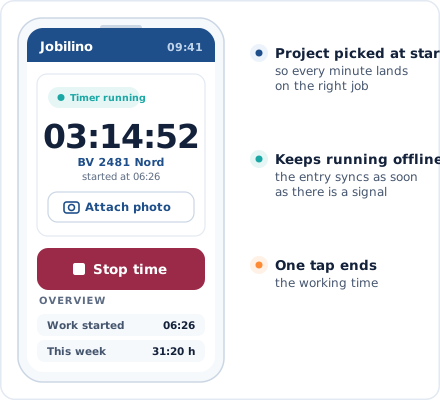
Instead of paper and a biro: one tap, and the working time sits cleanly in the system.
Digital time tracking instead of timesheets
Record working hours digitally right away instead of on paper.
Callback
What would this look like in your business?
A quick call: we look at your processes around “Jobilino vs. Paperwork” with you and tell you honestly whether and how Jobilino fits.
- We call you back – free & no obligation
- Reply within one business day · No sharing with third parties
Prefer to call right away? +43 664 5031382
Integrations & compatibility
Jobilino integrates easily into existing workflows and replaces paper timesheets entirely.
Existing processes
The switch starts with one team, not the whole company. The sheets run in parallel until the numbers match.
Payroll
Month-end goes to payroll or the tax advisor as a file – instead of a pile that has to be recorded there all over again.
Which industries benefit most from switching away from paper?
Companies with mobile employees in particular benefit greatly from digital time tracking.
Frequently asked questions about time tracking: paper vs. digital
Why switch from paper to digital time tracking?
Is digital time tracking complicated for employees?
Are times visible in the office immediately?
Can I create reports for payroll processing?
Switch from paper to digital time tracking
Reduce paperwork, save time in the office and create clear working hours across your company.
Prefer to call right away? +43 664 5031382